How much solar do you actually need?
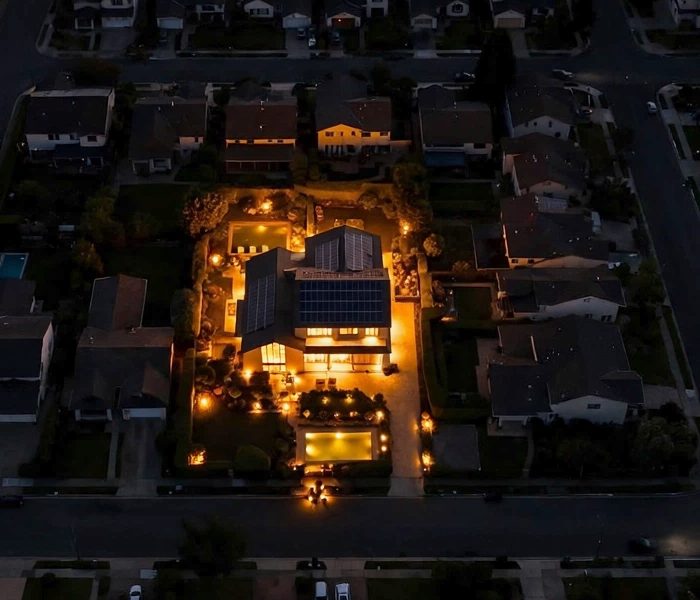
Work backwards from your daily load. Add up the watt hours your critical loads use in a day, then divide by your realistic sun hours (about 4 to 5 in much of the Midwest across the year, less in winter) and by a real world panel efficiency of about 0.75. A household protecting a fridge, a freezer, lights, and phones through an outage uses roughly 2,000 watt hours a day, which works out to about 600 watts of panels on paper, and 800 watts in practice once you round up for cloudy days.
The five words, defined before they are used
- Watt (W): how fast power is being used or produced right now. A panel rated 400W can produce up to 400 watts in perfect sun.
- Watt hour (Wh): an amount of energy. One watt for one hour, or 400 watts for 15 minutes. Batteries are sized in watt hours.
- Kilowatt hour (kWh): 1,000 watt hours. Your utility bill uses these. A 4,096Wh power station holds about 4.1 kWh.
- Sun hours: the day's sunlight compressed into equivalent hours of perfect sun. Five sun hours means a 400W panel makes roughly 2,000Wh that day before losses.
- Usable capacity: what a battery actually delivers, about 85 percent of its rating on this class of station.
A worked example, start to finish
Say your outage list is a fridge (about 1,440Wh a day at a 40 percent duty cycle), a chest freezer (about 1,150Wh), lights and phones (about 300Wh), and a router (about 290Wh). That is roughly 3,180Wh a day, call it 3,200. Your station loses about 15 percent in conversion, so your panels must harvest about 3,700Wh a day to break even. At 4.5 sun hours and 0.75 real world efficiency, each rated panel watt yields about 3.4Wh a day. 3,700 divided by 3.4 is about 1,090 watts of panels. Four 400W panels (1,600W) cover it with margin for a cloudy morning. Two panels (800W) cover about three quarters of it, which means the battery slowly drains across a long outage instead of holding even.
Now check the other ceiling: the station's solar input limit. A station capped at 800W of solar input (the BLUETTI Apex 300) cannot use four 400W panels no matter how well the math above works out. Sizing panels is two checks, the harvest you need and the doorway you have. Our panel compatibility explainer covers the doorway in detail.
Winter is the honest test
Midwest sun hours drop hard in winter, panels sit at a worse angle, and snow cover can zero out a day entirely. If your plan is winter storm backup, size with winter sun hours (often 2.5 to 3.5) or accept that solar slows the drain rather than stopping it. That is still valuable: a battery that would die at hour 20 lasting to hour 40 is the difference between a cold house and a manageable one. But go in with the real expectation, not the brochure one.
Who should skip this
Skip solar entirely if your outages are short and rare and you can recharge from a wall outlet or a vehicle between them, or if your only placement is a north facing, tree shaded spot. Panels you cannot place in sun are the most expensive decoration in this category.
Plain links to the manufacturer. We may earn a commission on purchases in the future; today these links are not tracked.
Your next step: run your own loads and get hours, not guesses.
Open the runtime calculator