Jackery vs EcoFlow portable lines
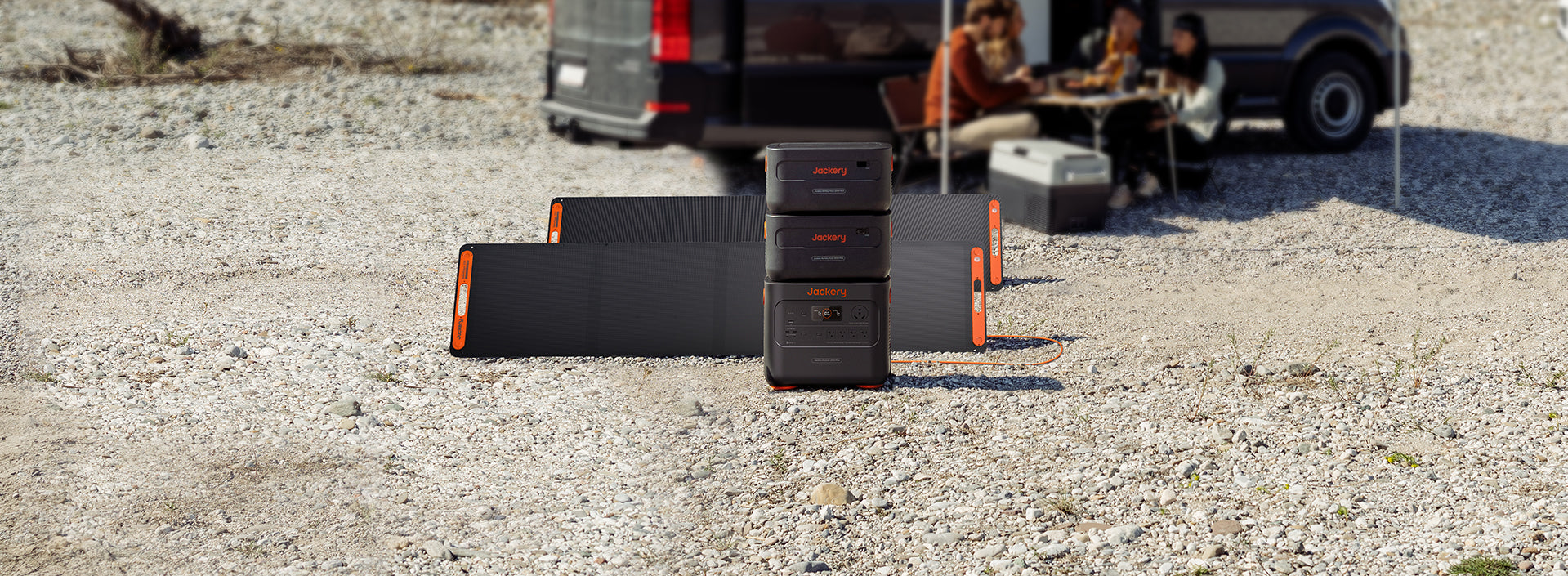
For portable duty, EcoFlow's RIVER and DELTA 2 lines and Jackery's Explorer lines cover the same ground at similar sizes, and the honest way to choose is the same math used everywhere on this site: usable watt hours (rated times 0.85), the solar input cap, and the warranty terms on the current model's official page. EcoFlow tends to compete on charging speed and solar input headroom. Jackery tends to compete on simplicity and its solar generator bundles. Neither tendency is a verdict; run your two finalist models through the numbers below.
Compare models, not brands
Brand level loyalty is how buyers overpay. Both ranges include small camping sized units (the RIVER 3 Plus and Explorer 300 Plus class), apartment sized units around 1,000Wh (DELTA 2 and Explorer 1000 v2 class), and large portables around 2,000Wh and up (DELTA 2 Max, Explorer 2000 Plus). Within any size class, the comparison that matters fits on an index card: rated capacity, your 85 percent usable figure, the solar input watts and voltage window, the AC output, the weight, and the warranty length on the official product page the week you buy. Specs in these lines revise often (both brands shipped updated generations recently), which is why this page teaches the comparison instead of freezing a spec table that would rot.
Solar input caps: the quiet decider
The pattern from our whole-home research repeats in miniature: the station with the bigger battery does not always accept the bigger array. A portable station capped at a low solar input refills slowly on a trip or during a long outage, and a matched folding panel from the same brand is not automatically the fastest legal input. Check the input window against the panel you already own or plan to buy using our compatibility explainer. It is a five minute check that decides whether your panels and your station are actually a system.
Warranty and support posture
Both brands publish warranty terms per model on their official pages, and terms differ across generations inside the same line, so the only honest advice is procedural: read the warranty section of the exact model, note whether the headline term needs a product registration to take effect, and keep the receipt and a photo of the serial label. Portable stations live hard lives in garages and truck beds; the warranty you actually hold is the one whose conditions you met, not the one in the advertisement.
Support reachability matters in this class for a practical reason: firmware updates, replacement cables, and expansion batteries all flow through the maker's store. Both brands sell their ecosystems direct and through major retailers, so parts and matched panels stay findable years later. That ecosystem depth, not any single spec, is the real moat the two big portable lines hold over the budget brands.
The index card, filled in for the apartment class
Here is the method worked once, on the size class most portable buyers actually purchase, using this site's standard load figures. Take any roughly 1,000Wh class station from either line (about 870 usable watt hours at the 85 percent factor) and the standard apartment list: a fridge averaging 60 watts, a router at 12, LED lights at 36.
| Load list | Average watts | Runtime on about 870 usable Wh |
|---|---|---|
| Fridge alone | 60 W | about 14.5 hours |
| Fridge, router, and lights | 108 W | about 8 hours |
| The same list, with a laptop added for a work day | 198 W | about 4.4 hours |
Now the solar half of the card: a matched 200W folding panel, at the sizing method used across this site (about 3.4 watt hours per rated watt on a decent day), returns roughly 680 watt hours a day, which is most of the fridge list's daily draw. That is why the bundles pair this class with a 200W panel, and why the input cap check in the previous section matters: a station that can only accept part of that panel gives the harvest back. Whichever brand's finalist you pick, run these three lines with its real rated capacity before you buy. The brand matters less than whether the card comes out in your favor.
Who should skip this
Skip both brands' portable lines if you need 240V or transfer switch duty. That is the whole-home class on our whole-home roundup, and forcing a portable to do it ends in returns.
Plain links to the manufacturer. We may earn a commission on purchases in the future; today these links are not tracked.
Your next step: see every portable station in one catalog and compare them.
Browse all generators