
Indiana winter outage guide
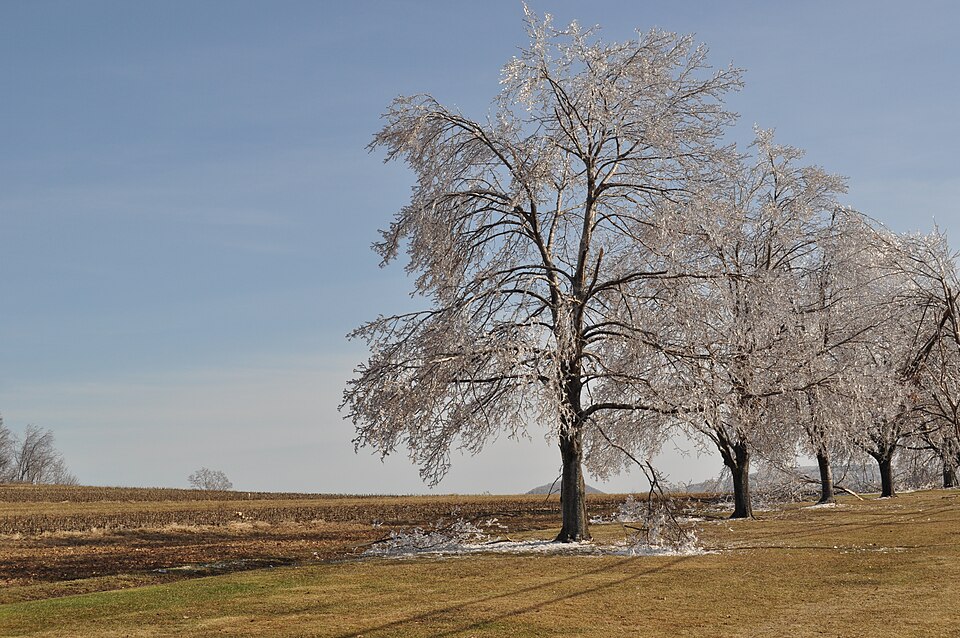
Indiana's winter problem is not the depth of its cold. It is ice. Indianapolis's January normals (National Weather Service, 1991 to 2020) are a high of 36.1 degrees F and a low of 20.9, with about 8.8 inches of snow in January and 25.5 in a year: milder than the states north of it, and sitting exactly in the temperature band where winter storms fall as freezing rain instead of snow. The Weather Service's Indianapolis office puts it plainly: ice usually makes a visit to central Indiana during the winter, and on occasion ice storms cause major problems. The record backs that up: roughly 200,000 homes out in the 1991 storm, 150,000 in 2005, over 200,000 in 2009. The home drill is the standard winter list (fridge, freezer, and the furnace fan, your gas furnace's electric blower): 770 watts at once, a starting push of about 1,850 watts, and about 340 watts on average. Five big utilities divide the state: AES Indiana in Indianapolis, NIPSCO in the northwest, Duke Energy Indiana across much of the south and center, CenterPoint Energy in the southwest, and Indiana Michigan Power in the northeast, with electric cooperatives across rural Indiana.
The Indiana winter you are actually planning for
Indianapolis is the reference city: January averages a high of 36.1 degrees F and a low of 20.9, December and February run a few degrees warmer, and the city's record low is minus 27 degrees F, set on January 19, 1994. Snow is modest by Great Lakes standards (about 25.5 inches in a normal year, against Chicago's 38.4). What those numbers mean for backup power is that an Indiana January outage is rarely a Minnesota-style deep-freeze emergency on its own. It becomes one when ice takes the power for days, which is the scenario this state's history keeps repeating, and why the furnace fan still outranks the fridge on the list: a house that cools for three days in the 20s is a pipe problem by day two.
The Indiana Department of Homeland Security adds a system worth knowing before you need it: counties issue travel advisories during winter storms, shown in real time on the department's county travel status map. Advisory means use caution, Watch means only essential travel is recommended, and Warning, the highest level, restricts travel to emergency workers. In an ice outage, that map tells you whether the hardware store run is a plan or a wish.
Ice: the cause with a record book
The National Weather Service's Indianapolis ice storm history is the core of this guide, and it deserves its numbers:
- March 12 to 13, 1991: 1 to 3 inches of ice across much of northern Indiana. Around 200,000 homes lost power at the height of it, nearly half a million people were affected, more than 100 steel power line towers were destroyed, and some rural areas were without power until early April.
- January 5 to 6, 2005: a widespread half inch of ice, with isolated amounts over an inch in north central Indiana; electricity knocked out for as many as 150,000 homes, and at least 1,000 residents went to Red Cross shelters.
- January 26 to 28, 2009: up to an inch of ice in southern Indiana, where over 200,000 homes and businesses lost power.
- January 31 to February 2, 2011: up to an inch of ice in parts of central Indiana plus winds gusting over 50 mph; power knocked out to over 80,000 residents, some for days.
The mechanism is weight: ice coats trees, power lines, and telephone lines until lines come down and trees break, as the Weather Service describes it. AES Indiana's own outage-cause table agrees on the everyday version: trees and branches on lines are a common cause year-round, and among weather causes, ice, high winds, and lightning are especially troublesome. It also notes the practical consequence for your timeline: major wind or ice storms are exactly the cases where the utility most often cannot give an early restoration estimate. Plan your battery and food clocks as if the estimate will be late, because in an ice storm it usually is.
Your power company, and how to check an outage
- AES Indiana (Indianapolis and central Indiana): check the online outage map for your estimated restoration time, or call the Lights Out Day and Night Line, 317-261-8111, 24 hours a day. AES offers outage alerts by email, text, and automated phone call. One map warning worth knowing: the map's dots are approximate and mark the equipment causing the outage, which is not always where the affected homes are.
- NIPSCO (northwest Indiana): outage map at nipsco.com/out. Report online or in the mobile app, by texting OUT to 444111, or by calling 1-800-464-7726. NIPSCO's network covers roughly 490,000 electric meters.
- Indiana Michigan Power (northeast Indiana, including Fort Wayne and the South Bend area, and southwest Michigan): outage map at IndianaMichiganPower.com/OutageMap, plus the I&M app and text or email alerts; phone 1-800-311-4634.
- Duke Energy Indiana (much of southern and central Indiana) and CenterPoint Energy (the southwest, including Evansville) serve the rest of the investor-owned map, alongside member-owned electric cooperatives in rural areas. Use your own utility's outage map and report line; in a regional ice storm it is the only timeline that describes your street.
- State guidance: the Indiana Department of Homeland Security's winter storms page (in.gov/dhs) carries the state's drill, summarized below.
The Indiana drill, on the clocks that matter
The state homeland security guidance for a winter outage is direct: notify your electric utility right away, gather everyone in the most insulated, interior room, and unplug most electronics to protect them from the surge when power returns, leaving one light switched on so you know the moment it does. If you use a fireplace or wood stove, have it cleaned before the season, to avoid carbon monoxide poisoning. Know how to shut off your water valves in case a pipe bursts from the cold, and check on neighbors, especially those with medical conditions. Layer on the site's standard clocks: the food clock starts when the power dies (a closed fridge holds safe temperatures about 4 hours, a full freezer about 48, per USDA guidance), the furnace fan goes on backup first in a cooling house, and exposed pipes can freeze within about six hours at 20 degrees F or below. The full drill is the Midwest winter storm checklist; the all-season kit is the national preparation checklist; the sizing behind every number is the sizing guide.
Questions readers ask
Who provides electricity in Indiana, and where do I check my outage?
Five investor-owned utilities divide most of the state: AES Indiana (Indianapolis; outage map online, or the Lights Out line at 317-261-8111), NIPSCO (northwest; map at nipsco.com/out, text OUT to 444111, or 1-800-464-7726), Indiana Michigan Power (northeast; map at IndianaMichiganPower.com/OutageMap, or 1-800-311-4634), Duke Energy Indiana (south and center), and CenterPoint Energy (southwest), with electric cooperatives across rural Indiana. Check your own utility's map first; it is the only timeline that describes your street.
Why is ice such a big deal in Indiana?
Because Indiana winters hover in the freezing rain band, and ice destroys by weight. The National Weather Service's Indianapolis history records about 200,000 homes without power in the March 1991 storm (1 to 3 inches of ice, some rural areas out until early April), 150,000 homes in January 2005, and over 200,000 homes and businesses in southern Indiana in January 2009. AES Indiana lists ice among its most troublesome weather causes, and notes that major ice storms are when early restoration estimates are hardest to give.
How cold does Indianapolis get in January?
By the National Weather Service's 1991 to 2020 normals: a normal high of 36.1 degrees F, a normal low of 20.9, about 8.8 inches of snow in January and 25.5 inches in a normal year. The city's record low is minus 27 degrees F (January 19, 1994). The cold alone is manageable; the outages that matter here are the multi-day ice events.
Who should skip this
Skip the state detail if your Indiana home has a standby generator that starts by itself; your winter work is the kit and the food clock on the national checklist. Skip the deep-freeze planning if you like; Indiana's record says to spend that effort on the ice scenario instead: days, not hours, and a utility that honestly cannot estimate your restoration time yet.
Your next step: run the winter list (fridge, freezer, furnace fan) against every battery we cover.
Open the calculator with the winter list ticked