
What size generator do I need?
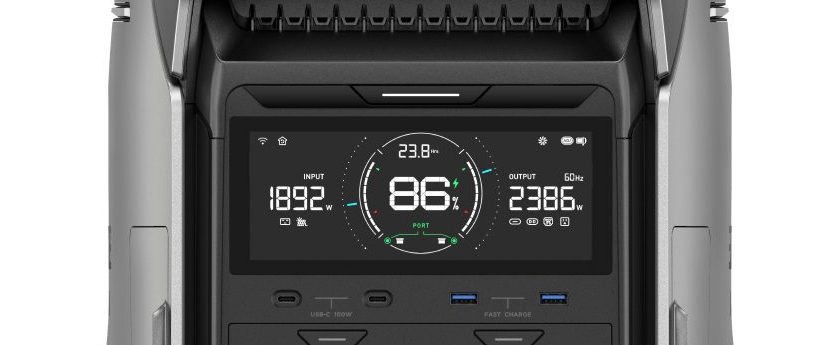
Size is three numbers, and a generator has to clear all three. Running watts: everything on your list switched on at once. Starting watts: that total plus the biggest extra push one motor needs in the second it starts. Watt hours (battery stations only): how much energy your list spends per hour, which decides how long the battery lasts. Take the list this site uses as its standard example (fridge, freezer, well pump, two sets of lights, two phones, and the internet router): it adds up to 1,402 running watts, a 3,402 watt starting target, and 322 watts spent per hour on average. A battery station fits that list when it can put out at least 1,402 watts without stopping, burst at least 3,402 watts for a motor start, and hold enough watt hours for the hours you want. The rest of this page shows where every one of those numbers comes from, so you can build your own list the same way.
Watts and watt hours are different things
Most sizing confusion is two words that sound alike.
- Watts (W) are how much power is flowing right now, like the speed of water in a pipe. A fridge uses about 150 watts while its motor runs.
- Watt hours (Wh) are an amount of energy, like the water in a tank. A battery rated 4,096 watt hours holds that much energy to spend.
- Running watts are what a thing uses while it runs normally.
- Starting watts (also called surge watts) are the bigger push a motor needs for about a second when it starts. A fridge that runs at 150 watts needs about 1,200 watts to start. If the generator cannot give that push, it can shut off, even with a full battery.
- Duty, or run share, is the part of each hour a thing actually runs. A fridge motor runs about 40 percent of the time and rests the rest, so its average draw is 150 times 0.40, about 60 watts. Averages, not ratings, decide how long a battery lasts.
- Usable watt hours are what a battery can actually hand over: about 85 percent of the printed size, because turning battery power into normal outlet power wastes some on the way out. This site plans every battery at 85 percent.
Fuel generators are sized on watts alone: they make power as long as fuel lasts, so there is no tank of watt hours to empty. Battery stations are sized on watts and watt hours: enough push, and enough tank.
Step 1: list what has to run, with honest watts
These are this site's audited planning figures for the loads in our runtime calculator, checked against manufacturer and US Department of Energy sources in our November 2026 wattage audit. Your appliance's own label beats any table, including this one, but these are the right starting numbers for typical modern appliances.
| Thing | Running watts | Share of the hour it runs | Average watts | Starting watts |
|---|---|---|---|---|
| Refrigerator | 150 | about 40% | 60 | 1,200 |
| Chest freezer | 120 | about 25% | 30 | 1,200 |
| Sump pump, 1/3 HP (horsepower, the motor's size) | 800 | about 10% | 80 | 2,000 |
| Sump pump, 1/2 HP | 1,050 | about 10% | 105 | 3,000 |
| Well pump, 1/2 HP | 1,000 | about 10% | 100 | 3,000 |
| Furnace fan (a gas furnace's blower) | 500 | about 50% | 250 | 1,500 |
| LED lights, one set of 4 bulbs | 36 | 100% | 36 | 40 |
| Phone charging | 20 | 100% | 20 | 25 |
| Internet router and modem | 20 | 100% | 20 | 25 |
| Laptop and monitor | 90 | 100% | 90 | 120 |
| TV and streaming box | 120 | 100% | 120 | 150 |
| CPAP (a small breathing machine used during sleep), no heated humidifier | 30 | 100% | 30 | 60 |
| Microwave | 1,500 | about 10% | 150 | 1,500 |
| Garage door opener | 550 | about 1% | about 6 | 1,400 |
| Washing machine | 500 | about 50% | 250 | 1,150 |
| Electric clothes dryer | 5,400 | about 50% | 2,700 | 6,750 |
Two rows deserve a second look. The microwave's running figure is what it pulls from the wall, which is more than the cooking power printed on its door. And the electric dryer is in a class of its own: at 5,400 running watts it is more than most home batteries can put out at all, which is why whole-house lists quietly leave it off.
Step 2: add your list up three ways
Running total: add the running watts of everything on your list. That is the least power the generator must give without stopping.
Starting target: take the running total and add the biggest single extra any one motor needs to start (its starting watts minus its running watts). Motors do not all start in the same second, so you add one extra, the largest, not all of them.
Average draw: add the average watts column. That is what your list spends per hour, and it is the number battery life comes from.
Four worked lists, all from the table above:
| List | Running total | Starting target | Average draw |
|---|---|---|---|
| Apartment basics: fridge, 2 sets of lights, phone, router, laptop | 352 W | 1,402 W | 262 W |
| Basement and food: fridge, freezer, 1/3 HP sump pump | 1,070 W | 2,270 W | 170 W |
| The standard home list: fridge, freezer, well pump, 2 sets of lights, 2 phones, router | 1,402 W | 3,402 W | 322 W |
| Most of the house: the standard list plus a sump pump, furnace fan, washer, microwave, TV, and laptop | 4,892 W | 6,892 W | 1,242 W |
Read the apartment row carefully, because it teaches the whole lesson: its running total is tiny (352 watts), but its starting target is 1,402 watts, because the fridge's start (an extra 1,050 watts) rides on top. A little 1,000 watt unit that looks fine on running watts will trip the first time the fridge starts. Size for the start, then check the run.
Each list is one tap away in the calculator, already ticked: apartment basics, basement and food, the standard home list, most of the house.
Step 3: turn the average into a battery size
For a battery station, the last step is hours. Multiply your average draw by the hours you want to cover, then divide by 0.85, because only about 85 percent of the printed battery size is yours to spend. The answer is the smallest printed battery size that does the job.
| Goal | Energy your list spends | Printed battery size to shop for |
|---|---|---|
| Standard home list through a 12 hour night (322 W average) | about 3,864 Wh | about 4,550 Wh or more |
| Standard home list for a full day (322 W average) | about 7,728 Wh | about 9,100 Wh or more |
| Basement and food for a full day (170 W average) | about 4,080 Wh | about 4,800 Wh or more |
| Apartment basics for a full day (262 W average) | about 6,288 Wh | about 7,400 Wh or more |
Those are big numbers, and they explain the two honest shortcuts. First, solar panels refill the battery during the day, so a station with a strong solar input can be smaller than the full-day row suggests; our solar sizing guide does that math. Second, most outages are not a full day. Sizing for the outage you actually fear (a night, a workday) instead of the worst one on record is how normal households afford this. The runtime explainer walks the same math one appliance at a time.
For a fuel generator, skip this step: check the two watt numbers, then think about fuel. A generator that clears your starting target at breakfast clears it at midnight, as long as the tank or the propane lasts.
The three sizing mistakes that cost people money
- Sizing by running watts alone. The fridge start, the pump start, the furnace fan start: the trip always happens at a start, not during a run. If a listing leads with a huge watt number, check whether it is the starting (surge) figure being sold as the running one. Our buying mistakes checklist shows the spec-sheet lines that give this away.
- Sizing by the printed battery size alone. 4,096 printed watt hours is about 3,482 you can spend. Comparing printed sizes between brands is fair; planning your night on the printed size is not.
- Forgetting the one load that changes the class. An electric dryer (5,400 W), a big well pump, or electric heat can move a house from a mid-size battery to a 240 volt fuel generator or a standby unit in one line of the list. Find that load first, then size. The house connection guide explains what 240 volt backup takes.
Questions readers ask
What size generator do I need to run a refrigerator?
Two checks. The generator must burst at least about 1,200 watts for the fridge's start and give 150 watts while it runs, which nearly every station over 1,000 watts of output clears. The battery size is about hours: a fridge averages about 60 watts, so 1,000 usable watt hours (about 1,180 printed) runs it for roughly 16 hours. The fridge checker runs your fridge against every battery we cover.
What size generator do I need for a whole house?
For the "most of the house" list on this page, the targets are 4,892 running watts and a 6,892 watt starting target, which is 240 volt territory: the biggest battery stations or a mid-size fuel generator, connected through an inlet box and a transfer switch or interlock, never a cord into a wall outlet. Whole-house coverage also leaves the electric dryer and electric heat off the list in almost every real setup.
Is a 2,000 watt generator enough for a house?
For the apartment basics list, yes, with room to spare: 352 running watts against a 1,402 watt starting target. For the standard home list, no: its running total (1,402 W) fits, but its starting target is 3,402 watts, so a 2,000 watt unit trips when the well pump or fridge starts. The starting target is the number that decides.
How many watt hours do I need for one night?
Multiply your list's average draw by the hours and divide by 0.85. The standard home list averages 322 watts, so a 12 hour night needs about 3,864 watt hours of spending, which means shopping for a printed battery size of about 4,550 watt hours or more, or a smaller battery plus solar refilling it the next morning.
Do I add up every appliance's starting watts?
No. Motors almost never start in the same second, so the honest target is the running total plus the single biggest starting extra on your list. On the standard home list that extra is the well pump's (3,000 starting minus 1,000 running, an extra 2,000), which is how 1,402 running watts becomes a 3,402 watt starting target.
Who should skip this
Skip the arithmetic if your outages are short and your list is a fridge and phones: almost any 1,000 watt class station covers that, and your time is better spent on the preparation checklist. Skip battery sizing entirely if your list includes electric heat or an electric dryer for long outages; that is fuel generator or standby territory, and the calculator will show you the fuel picks for the same list.
Your next step: tick your own list and see the generators that fit it, with hours.
Open the calculator with the standard home list ticked